

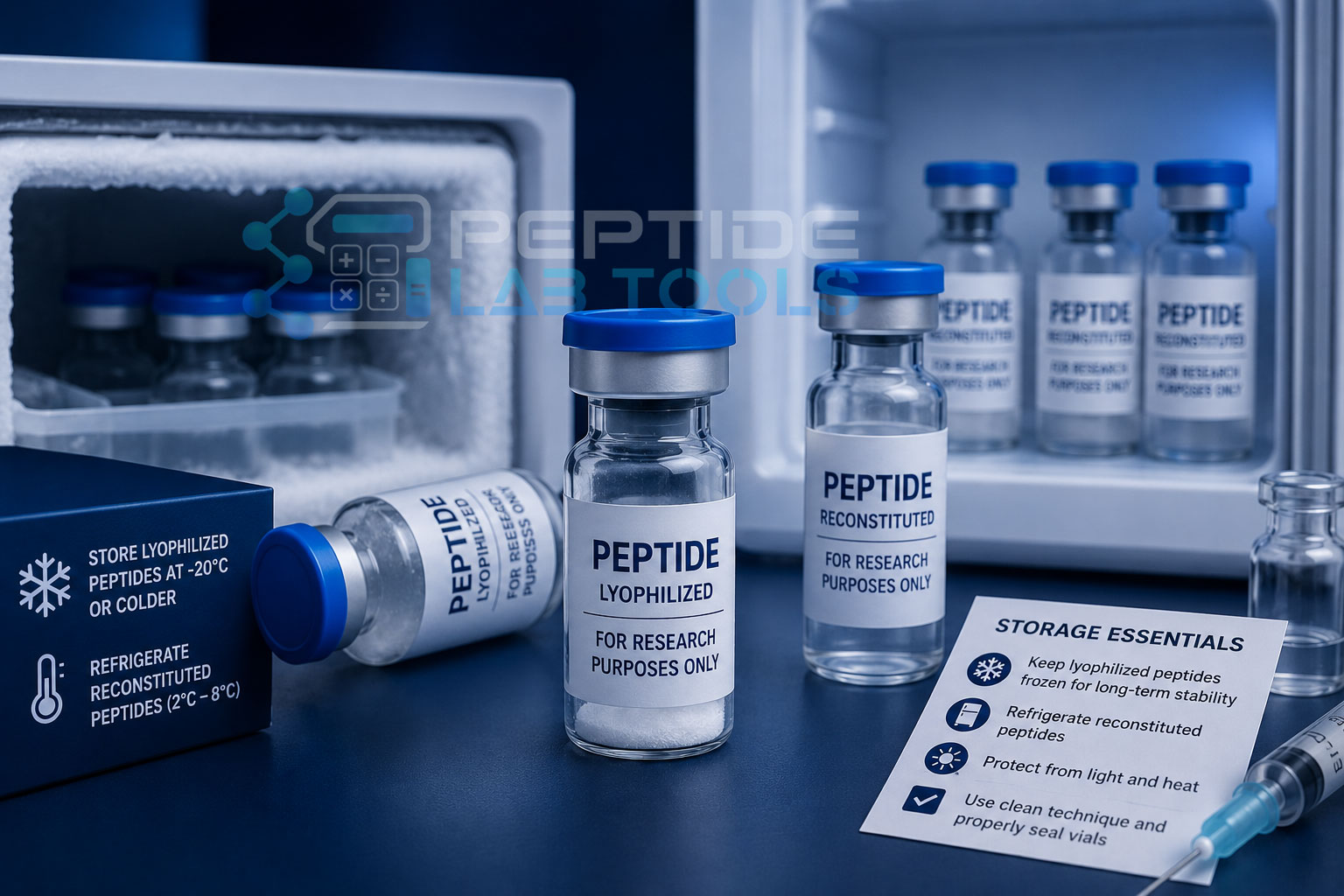
Proper peptide storage helps protect a peptide from degradation before and after it is reconstituted. Temperature, moisture, light, contamination, and repeated temperature changes can all affect stability, and the best storage conditions are different for a dry lyophilized peptide than for a peptide that has already been mixed with liquid. For most lyophilized peptides, cold storage is preferred. Peptides that will be stored longer term are generally best kept frozen at approximately -20°C, while -80°C may be used for very long-term laboratory storage when available.
When properly stored in their dry lyophilized form at around -20°C, many peptides can remain stable for several years. Reconstituted peptides are different. Once liquid has been added, most peptide solutions are commonly kept refrigerated at approximately 2°C to 8°C unless specific product information provides different instructions. Repeated freezing and thawing of a reconstituted working vial should generally be avoided.
Why Peptide Storage Matters
Peptides are chains of amino acids that can gradually degrade when exposed to unfavorable environmental conditions. Heat, moisture, oxidation, strong light, contamination, and repeated freeze-thaw cycles can all contribute to changes in peptide stability. Lyophilization, commonly called freeze-drying, removes most of the water from a peptide before it is sealed in a vial. This dry state is one of the reasons lyophilized peptides are generally much more stable than peptides that have already been dissolved in liquid.
Once a peptide is reconstituted, water is introduced back into the vial and the peptide becomes a solution. The storage requirements therefore change, and temperature, sterility, and time become more important considerations.
How to Store Lyophilized Peptides
For most unopened lyophilized peptides, the best storage method depends mainly on how long the vial will sit before it is needed. If a peptide will be used relatively soon, refrigerated storage at approximately 2°C to 8°C is commonly used. However, if the peptide will remain unused for several weeks, a month, or longer, storing the dry vial in a freezer at approximately -20°C is generally the better choice. Major peptide manufacturers and laboratory suppliers commonly recommend -20°C for storage of lyophilized peptides.
For very long-term storage, temperatures around -80°C may provide additional stability, although a deep freezer is not necessary for the typical person storing peptide vials. A normal household freezer operating around -18°C to -20°C is therefore a practical option for longer-term peptide storage. Keep the vial sealed, dry, protected from unnecessary light, and ideally inside a small sealed container or bag. If several vials were purchased at the same time, a simple approach is to keep the unused stock frozen and remove one vial at a time as it is needed.
How Long Can Lyophilized Peptides Be Stored?
One of the major advantages of keeping peptides lyophilized is their long storage potential. When properly sealed and stored at approximately -20°C, many lyophilized peptides can remain stable for several years. Thermo Fisher’s peptide handling guidance specifically notes that lyophilized peptides stored at -20°C may remain stable for several years, and other major peptide suppliers similarly recommend -20°C or colder for long-term storage. That does not mean every peptide is guaranteed to retain exactly the same stability for the same number of years.
Individual peptide sequences can differ in their sensitivity to oxidation, moisture, temperature, and other forms of degradation. However, for general peptide storage, keeping unopened vials in their dry lyophilized form at approximately -20°C is far preferable to reconstituting them months in advance. For people who buy several peptide vials at once, the practical strategy is simple: keep the unused vials frozen and only reconstitute a vial when it is actually needed.
Can Lyophilized Peptides Be Stored at Room Temperature?
Many lyophilized peptides can tolerate limited periods at controlled room temperature. This is one reason peptide shipments commonly travel without remaining frozen throughout the entire delivery process. Laboratory suppliers note that dry lyophilized peptides can remain stable for days to weeks at ambient temperatures. That does not mean room temperature is the ideal place to deliberately store them for months.
There is also an important difference between ordinary indoor room temperature and excessive heat. A vial sitting in a climate-controlled room around 20°C to 22°C is very different from one sitting inside a hot vehicle, mailbox, sunny window, or outdoor delivery box. For short periods, ordinary room-temperature exposure is unlikely to be as concerning for a dry peptide as it would be for a reconstituted peptide. For intentional longer-term storage, however, approximately -20°C remains the better choice for most lyophilized peptides.
Always Let a Frozen Peptide Warm Up Before Reconstituting It
A frozen lyophilized peptide should be allowed to warm completely to room temperature while the vial is still sealed before it is opened, punctured, or reconstituted. Do not remove a vial directly from the freezer and immediately add bacteriostatic water. The reason is moisture and condensation. When a very cold vial is exposed to warmer air, condensation can form on and potentially around the container.
Opening or accessing the vial while it is still cold increases the possibility of moisture entering the vial. One of the main benefits of lyophilization is keeping the peptide dry during storage. Introducing moisture before reconstitution unnecessarily works against that advantage. Leave the vial sealed and allow it to naturally reach room temperature.
There is no need to heat it, place it in warm water, or use another method to speed up the process. Once the vial has reached room temperature, it can be prepared and reconstituted normally. A useful sequence to remember is: Freezer → sealed vial warms to room temperature → reconstitute
Does a Frozen Peptide Need to Thaw in the Refrigerator First?
For a typical small lyophilized peptide vial stored around -20°C, there is usually no need for a separate refrigerator-thawing stage. The important part is allowing the sealed vial to reach room temperature before it is opened or reconstituted. Moving it from the freezer to the refrigerator first is not necessarily harmful, but it adds another step and does not remove the need to let the vial warm further before reconstitution. Avoid repeatedly moving unused vials between the freezer, refrigerator, and room temperature.
If a vial is not needed yet, leaving it consistently frozen is generally preferable.
How to Store Peptides After Reconstitution
Once a peptide has been reconstituted, refrigerated storage is the usual practical approach for most peptide solutions. A refrigerator temperature of approximately 2°C to 8°C is commonly used unless the specific peptide or product provides different storage instructions. Keep the vial in the main refrigerator compartment where the temperature remains relatively stable. The refrigerator door is less desirable because it is exposed to warmer air and repeated temperature changes whenever the door is opened.
At the opposite extreme, do not place the vial directly against a freezer plate, cooling element, or exceptionally cold surface where the solution could accidentally freeze. Keeping the vial upright inside a small container can make storage easier, reduce unnecessary movement, and protect it from light and spills. Once reconstituted, the peptide should remain properly closed between uses. If the vial is being accessed repeatedly, use clean technique and a new sterile syringe and needle each time rather than leaving a needle inserted into the stopper.
How Long Do Reconstituted Peptides Last in the Refrigerator?
There is no exact storage period that applies to every peptide once it has been reconstituted. Different peptide sequences can have different stability in solution, and concentration, diluent, temperature, sterility, and formulation can all affect how long a peptide remains stable. For online peptides reconstituted with bacteriostatic water, approximately 28 to 30 days is commonly used as a practical working timeframe. However, this should not be interpreted as a universal expiration date for every peptide.
A peptide does not automatically become unusable the moment day 30 arrives, nor does the 30-day guideline guarantee that every peptide maintains identical stability for the entire period. Some peptides may remain chemically stable longer under appropriate refrigerated conditions, while others may be less stable in solution. When product-specific stability information is available, it should take priority over a general timeframe. This is another reason not to reconstitute several vials long before they are needed.
A dry peptide can generally be preserved far longer in the freezer than the same peptide can be stored after it has been mixed.
Should Reconstituted Peptides Be Frozen?
For an actively used reconstituted vial, freezing is generally not the preferred storage method. Peptide solutions can sometimes be frozen for longer-term laboratory storage, but this is usually done by dividing the solution into individual single-use aliquots before freezing. Each aliquot can then be thawed once when it is needed. The reason is that repeated freeze-thaw cycles can contribute to degradation, aggregation, precipitation, or other changes in some peptide solutions.
The sensitivity varies between peptides, but repeatedly freezing and thawing the same working vial is generally best avoided. For typical peptide storage, the simpler strategy is to keep unused lyophilized vials frozen and keep the currently reconstituted vial refrigerated. If a particular peptide has specific validated instructions allowing its reconstituted solution to be frozen, those instructions can be followed. Otherwise, freezing should not automatically be used as a way of extending the life of an actively used vial.
Why Repeated Freeze-Thaw Cycles Matter
Temperature cycling is different from simply storing a peptide at a cold temperature. When a peptide solution freezes, ice formation can temporarily concentrate dissolved material within the remaining unfrozen portion of the liquid. As the solution freezes and thaws repeatedly, some peptides may become more susceptible to aggregation, precipitation, or other physical changes. This is why laboratory peptide solutions intended for frozen storage are commonly separated into smaller aliquots rather than repeatedly thawing one large container.
Unnecessary temperature cycling should also be minimized with dry lyophilized vials. If several vials are stored in the freezer, remove only the one you intend to use rather than repeatedly warming the entire supply.
Does Light Affect Peptides?
Some peptides are light-sensitive, and prolonged exposure to strong light can contribute to degradation. Direct sunlight is particularly undesirable because it combines light exposure with the potential for substantial heat. Keeping peptide vials inside their original packaging or another closed storage container provides simple protection from unnecessary light. There is no need to worry about brief exposure to ordinary indoor lighting or the refrigerator light turning on when the door opens.
The main concern is unnecessary prolonged exposure, particularly to direct sunlight or strong light sources.
Why Heat Is a Problem for Peptide Storage
Excessive heat can accelerate chemical degradation and is one of the easiest storage problems to avoid. Cars are a common example. Even when the outside temperature seems reasonable, the interior of a parked vehicle can become significantly hotter. A vehicle is therefore a poor long-term storage location for either dry or reconstituted peptides.
Mailboxes, outdoor delivery boxes, windowsills, garages, and areas near heating equipment can create similar problems. Dry lyophilized peptides are generally more tolerant of temporary temperature exposure than reconstituted solutions, but that does not mean excessive heat is harmless. Once peptide vials arrive, move them into appropriate storage rather than leaving them exposed to uncontrolled temperatures.
What If a Peptide Arrives Warm?
A dry lyophilized peptide arriving at ordinary room temperature does not automatically mean it has been damaged. Lyophilized peptides are commonly shipped at ambient temperature, and many can tolerate days or even weeks under normal shipping conditions. This is very different from prolonged exposure to extreme heat. If an unopened peptide arrives at ordinary room temperature and there is no reason to believe it experienced severe heat exposure, place it into the appropriate storage conditions after receiving it.
If the vial will not be needed soon, that generally means placing the sealed lyophilized peptide into the freezer at approximately -20°C. There is no advantage to immediately reconstituting the peptide simply because it arrived at room temperature. Keeping it dry preserves the more stable lyophilized form.
What If a Reconstituted Peptide Is Left Out of the Refrigerator?
A reconstituted peptide being left at room temperature briefly does not automatically mean it has been destroyed. The significance depends on the individual peptide, the actual temperature, and how long it remained outside refrigeration. A vial sitting on a counter in a climate-controlled room for a short time is very different from being left inside a hot vehicle for several hours. Unfortunately, there is no universal formula that can convert a temperature excursion into an exact percentage of potency lost.
If a refrigerated peptide is accidentally left out briefly, return it to its proper refrigerated storage. Avoid repeatedly allowing the vial to warm and cool unnecessarily. A prolonged or extreme temperature excursion creates more uncertainty, particularly when the peptide has already been reconstituted.
Where in the Refrigerator Should Reconstituted Peptides Be Stored?
The best location is one that remains consistently refrigerated without becoming cold enough to freeze the solution. Avoid the refrigerator door because its temperature changes more frequently. Also avoid locations directly beside cooling vents or surfaces where liquids have a tendency to freeze. A small covered container on a stable interior shelf works well for keeping peptide vials upright, organized, protected from unnecessary light, and away from food spills or frequent handling.
The goal is not to find the coldest place in the refrigerator. It is to maintain a consistent temperature of approximately 2°C to 8°C.
Where in the Freezer Should Lyophilized Peptides Be Stored?
For longer-term dry storage, a stable area inside the freezer is preferable to the freezer door. Keeping peptide vials inside a sealed container or freezer bag provides additional protection and makes it easier to organize several vials without repeatedly handling them. The freezer door tends to experience more temperature fluctuation each time it is opened, so an interior location is generally preferable. When a vial is eventually removed for use, leave it sealed until it has warmed completely to room temperature before reconstituting it.
How Should Bacteriostatic Water Be Stored?
Bacteriostatic Water for Injection has different storage requirements from the peptide that may eventually be reconstituted with it. Commercial bacteriostatic water is commonly labeled for controlled room-temperature storage around 20°C to 25°C. It does not automatically need to be refrigerated simply because a reconstituted peptide will later be kept in the refrigerator. The vial should be protected from excessive heat and handled cleanly each time it is accessed.
After a multi-dose vial has been punctured, keep track of the date it was first opened. General multi-dose vial guidance commonly uses a 28-day period after first puncture unless the manufacturer provides a different timeframe. The important point is that the bacteriostatic water and the reconstituted peptide are two separate products with potentially different storage requirements.
Does Bacteriostatic Water Need to Be Refrigerated After Opening?
Generally, no. Bacteriostatic water does not automatically require refrigeration after the first puncture. Commonly available Bacteriostatic Water for Injection is labeled for controlled room-temperature storage at approximately 20°C to 25°C. The manufacturer’s instructions should therefore be followed rather than assuming that colder storage must be better.
The important considerations after opening are keeping the vial clean, using a new sterile needle and syringe when accessing it, and keeping track of when it was first punctured. Once that water has been used to reconstitute a peptide, the storage requirements of the resulting peptide solution are a separate issue.
Traveling With Peptides
Travel is easier with an unopened lyophilized peptide than with a peptide that has already been reconstituted. Dry peptides can generally tolerate temporary room-temperature conditions better than peptide solutions, although excessive heat should still be avoided. If an unopened vial is normally kept frozen, it can be transported under appropriately cool conditions when practical. A reconstituted peptide that requires refrigeration should be transported in an insulated container with an appropriate cold source.
Do not place the vial directly against a frozen ice pack if doing so could freeze the solution. A small barrier between the vial and the frozen pack can help keep the environment cool without exposing the peptide to an extreme cold spot. During longer trips, maintaining a reasonably consistent cool temperature is preferable to repeatedly allowing the peptide to become warm and then making it extremely cold again.
Can You Tell If a Peptide Has Gone Bad?
Sometimes there are visible warning signs, but appearance alone cannot confirm peptide potency or sterility. After reconstitution, unexpected cloudiness, visible particles, significant discoloration, unusual precipitation, a damaged vial, or a compromised rubber stopper can all indicate a problem. However, a perfectly clear solution does not guarantee that no degradation has occurred. Chemical changes can occur without producing an obvious visual difference, and microbial contamination is not necessarily visible.
The same principle applies to dry lyophilized material. Its appearance can sometimes indicate an obvious problem, but appearance alone cannot tell you exactly how much active peptide remains.
Should You Reconstitute Peptides Before Long-Term Storage?
Generally, no. If a peptide is not going to be needed soon, keeping it in its dry lyophilized state is normally the better approach. Properly frozen dry peptides can often be stored for years, while peptide solutions generally have a much shorter useful storage period. If several vials are available, keep the unused stock sealed and frozen at approximately -20°C and reconstitute one vial at a time.
When the next vial is needed, remove it from the freezer, allow the sealed vial to reach room temperature, and only then begin reconstitution. Our complete guide on how to reconstitute peptides explains the full process, including bacteriostatic water, reconstitution volume, concentration, syringe units, and proper mixing technique.
Peptide Storage Before and After Reconstitution
The easiest way to manage peptide storage is to separate long-term dry storage from short-term solution storage. For most lyophilized peptides, approximately -20°C is the practical choice for longer-term storage. When stored properly in this dry, sealed state, many peptides can remain stable for several years. Refrigeration can be suitable when a dry vial will be used relatively soon, while normal room-temperature exposure is generally better treated as temporary rather than the preferred long-term storage method.
When a frozen lyophilized peptide is needed, allow the sealed vial to warm completely to room temperature before opening, puncturing, or reconstituting it. This helps prevent condensation and unnecessary moisture exposure. After reconstitution, most peptide solutions are instead kept refrigerated at approximately 2°C to 8°C. Avoid repeatedly freezing and thawing a working vial, protect it from excessive heat and direct light, and minimize unnecessary temperature changes.
For unused peptide stock, the general strategy is simple: keep it dry, keep it sealed, keep it frozen, and reconstitute one vial at a time as it is needed.