

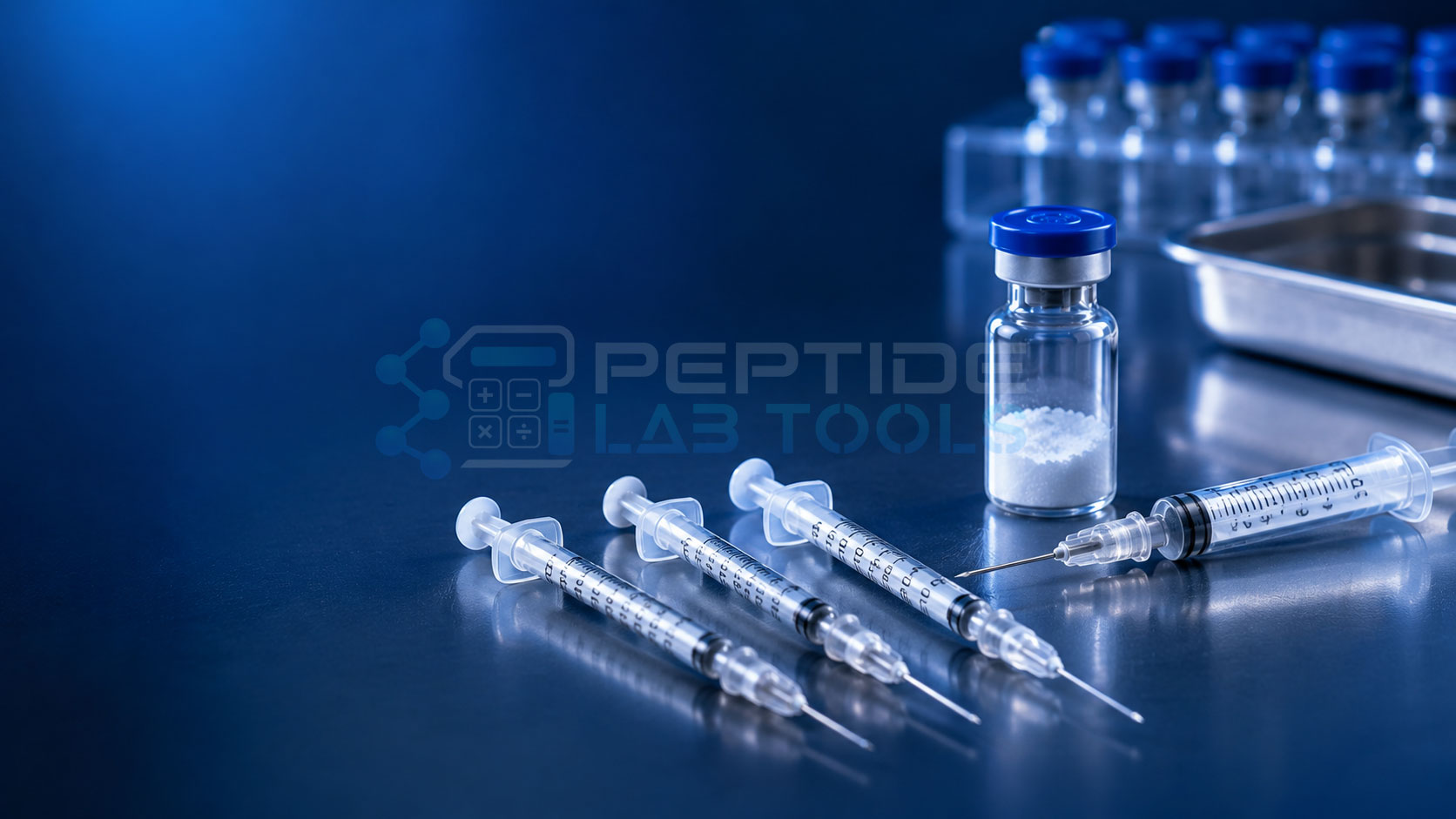
Choosing the right syringe for peptides can make small liquid measurements considerably easier to read and measure accurately. Insulin syringes are commonly used for small-volume measurements because their barrels are marked in easy-to-read units, while larger syringes can be more convenient when transferring bacteriostatic water during peptide reconstitution. The most common peptide calculations use U-100 insulin syringe markings. With a U-100 syringe, 100 units equals 1 mL of liquid, which means 10 units equals 0.1 mL and 1 unit equals 0.01 mL.
The amount of peptide represented by those units depends entirely on the concentration of the reconstituted vial. Syringe capacity is only one part of choosing the right syringe. Needle gauge, needle length, barrel markings, fixed versus detachable needles, and the amount of dead space inside the syringe can all make a difference. This guide explains how the common syringe sizes work and when a larger syringe may be more practical for peptide reconstitution.
What Is a U-100 Insulin Syringe?
A U-100 insulin syringe is designed around a concentration of 100 insulin units per milliliter. The markings printed on the barrel therefore divide 1 mL of liquid into 100 units. For peptide calculations, those markings provide a convenient way to measure small liquid volumes. The syringe is not actually measuring milligrams or micrograms of peptide, and the word “unit” on the barrel should not be confused with a biological unit of a medication.
On a U-100 syringe:
100 units = 1 mL
50 units = 0.5 mL
30 units = 0.3 mL
20 units = 0.2 mL
10 units = 0.1 mL
5 units = 0.05 mL
1 unit = 0.01 mL
This relationship remains the same regardless of how concentrated the peptide solution is. What changes is how much peptide is contained within each unit of liquid. For example, 10 units always represents 0.1 mL on a U-100 syringe. However, that 0.1 mL could contain 100 mcg, 250 mcg, 500 mcg, or another amount depending on how the vial was reconstituted.
The Three Main Insulin Syringe Sizes
The three most common U-100 insulin syringe capacities are 0.3 mL, 0.5 mL, and 1 mL. These are also commonly described as 30-unit, 50-unit, and 100-unit syringes. All three measure the same liquid using the same U-100 relationship. A line representing 10 units still represents 0.1 mL regardless of which syringe is being used.
The main difference is the total capacity of the barrel and how much space is available between the markings. A smaller barrel spreads a smaller volume across approximately the same physical syringe length, which can make small measurements easier to see.
0.3 mL or 30-Unit Insulin Syringes
A 0.3 mL U-100 insulin syringe holds a maximum of 30 units, or 0.3 mL. This is often the easiest syringe size for reading very small liquid volumes because the scale is spread across a relatively small total capacity. Some 0.3 mL syringes are marked in single-unit increments, while others are available with half-unit markings. A half-unit marking on a U-100 syringe represents 0.005 mL.
That can be useful when a calculation produces a very small draw volume that falls between full-unit markings. The disadvantage of a 0.3 mL syringe is simply its limited capacity. If a required liquid volume is greater than 30 units, a larger syringe is needed. For small peptide draw volumes, however, a 30-unit syringe is often easier to read than using only the bottom portion of a 100-unit syringe.
0.5 mL or 50-Unit Insulin Syringes
A 0.5 mL U-100 insulin syringe holds 50 units, or 0.5 mL. This size provides a useful middle ground between the compact 30-unit syringe and the larger 100-unit syringe. It can accommodate considerably more liquid than a 0.3 mL syringe without requiring a full 1 mL barrel. For measurements that regularly fall somewhere between approximately 20 and 50 units, a 0.5 mL syringe can be convenient because the relevant portion of the scale occupies more of the barrel than it would on a 1 mL syringe.
As with every syringe, check the actual graduations printed on the barrel rather than assuming that every manufacturer uses identical minor markings.
1 mL or 100-Unit Insulin Syringes
A 1 mL U-100 insulin syringe holds a maximum of 100 units. This is the largest of the standard insulin syringe sizes and gives the greatest flexibility when a larger liquid volume needs to be measured. The tradeoff is that very small measurements occupy less physical space on the barrel compared with a 0.3 mL or 0.5 mL syringe. A 100-unit syringe does not make a solution less accurate or change its concentration.
It simply provides a larger measuring scale. For example, 5 units on a 30-unit U-100 syringe and 5 units on a 100-unit U-100 syringe both represent exactly 0.05 mL. The smaller syringe may simply make that small amount easier to identify visually. This is why the largest syringe is not automatically the best syringe for every measurement.
Which Insulin Syringe Size Is Best for Peptides?
There is no single syringe capacity that is best for every peptide concentration. The most practical syringe is generally the smallest one that comfortably holds the required liquid volume while providing markings that are easy to read. If a calculated volume is only a few units, a 30-unit syringe can make those markings easier to distinguish. If the volume is regularly above 30 units, a 50-unit syringe may be more practical.
For volumes approaching or exceeding 50 units, a 100-unit syringe provides the necessary capacity. This is also one reason peptide concentration matters. Two differently reconstituted vials containing the same total amount of peptide can require completely different liquid volumes for the same measured amount. Instead of choosing a syringe first and forcing the concentration to work around it, the concentration and expected draw volume can be considered together.
Why Smaller Syringes Can Be Easier to Read
Imagine trying to accurately measure a very small amount of liquid using a large measuring cup. It can technically be done if the markings are precise enough, but a smaller measuring device usually makes the amount easier to see. The same basic principle applies to syringes. A 0.3 mL syringe uses its barrel to display only 30 U-100 units, while a 1 mL syringe must display 100 units over a similar overall length.
This gives manufacturers more physical room to separate small measurements on a lower-capacity syringe. Some 0.3 mL syringes go even further by providing half-unit graduations. The actual printed scale still matters, so always look at the syringe itself rather than relying only on the capacity printed on the box.
Understanding Syringe Markings
Before measuring any liquid, determine what each small line on the syringe actually represents. The numbered markings usually identify larger increments, while smaller lines between those numbers represent intermediate amounts. Depending on the syringe, those smaller markings may represent half a unit, one unit, two units, or another increment. Never assume that every insulin syringe uses exactly the same minor graduation pattern simply because two syringes both use the U-100 scale.
Start at zero and count the spaces between known numbered markings if there is any uncertainty. The syringe packaging should also specify its graduation scale. When measuring a liquid, read the position of the leading edge of the rubber plunger against the scale rather than estimating from the center or back of the stopper.
U-100 Syringe Units Are Measurements of Volume
One of the most important concepts in peptide measurement is that syringe units and peptide amounts are two different things. On a U-100 syringe, a unit is simply a convenient representation of liquid volume:
1 syringe unit = 0.01 mL
That does not mean one syringe unit equals 1 mcg, 10 mcg, 100 mcg, or 1 mg of peptide. The peptide amount represented by that liquid depends on the concentration of the solution. If a vial contains 5 mg/mL, then 10 units, or 0.1 mL, contains 0.5 mg. If the same vial were reconstituted to a concentration of 2.5 mg/mL, the same 10 syringe units would contain only 0.25 mg.
The syringe did not change. The concentration did.
Do Not Confuse U-100 With U-40 or U-500 Syringes
Not every insulin syringe uses a U-100 scale. U-40 syringes are designed for insulin containing 40 units per milliliter, while U-500 syringes are designed for highly concentrated U-500 insulin. Their printed scales do not represent volume in the same way as a U-100 syringe. Peptide calculators that provide “syringe units” generally assume a standard U-100 syringe unless they specifically state otherwise.
Using a U-40 or U-500 syringe while interpreting the markings as U-100 measurements can create a significant volume error. For peptide calculations based on U-100 units, confirm that the syringe package specifically says U-100.
What Does Needle Gauge Mean?
Needle gauge describes the outside diameter of the needle. The numbering system can initially seem backward because a higher gauge number means a thinner needle. For example, a 31-gauge needle is thinner than a 29-gauge needle. Insulin syringes are commonly available with fine needles in approximately the 29G to 31G range, although other gauges also exist.
Modern short insulin syringes commonly use needles around 31G. A thinner needle can reduce the size of the puncture, but gauge is only one characteristic of a needle. Length, wall thickness, flow resistance, solution viscosity, and how the needle is being used also matter. For thin water-based peptide solutions, very fine insulin syringe needles are generally capable of handling the small liquid volumes involved.
What Does Needle Length Mean?
Needle length is exactly what it sounds like: the distance from the base of the exposed needle to its tip. Common insulin syringe needle lengths include approximately 6 mm, 8 mm, and 12.7 mm, which is equivalent to about 1/4 inch, 5/16 inch, and 1/2 inch. Modern insulin syringes have increasingly moved toward shorter needles. For example, 6 mm × 31G insulin syringes are widely available alongside older 8 mm and 12.7 mm designs.
Needle length does not affect the amount of liquid represented by the syringe markings. A 30-unit U-100 syringe remains a 0.3 mL syringe whether its attached needle is 6 mm or 12.7 mm long. Capacity tells you how much liquid the syringe can hold. Gauge tells you how thick the needle is. Length tells you how long the needle is. These are three separate specifications.
29G vs 30G vs 31G Needles
The difference between neighboring needle gauges is relatively small but noticeable. A 29G needle is slightly thicker than a 30G needle, and a 30G needle is slightly thicker than a 31G needle. All three are commonly encountered on insulin-style syringes. For low-viscosity water-based solutions, a 30G or 31G needle can still allow liquid to pass through without requiring the much larger needles used for thicker oil-based solutions.
Older insulin syringes frequently used longer 29G or 30G needles, while many current products use shorter 31G needles. There is no reason to assume that a larger needle is automatically better simply because liquid may move through it slightly faster. For small volumes, the fine fixed needles found on modern insulin syringes are specifically designed for accurate small-volume delivery.
Fixed-Needle vs Detachable-Needle Syringes
Most insulin syringes have a permanently attached needle. The needle and barrel are manufactured as a single unit and are discarded together after use. Larger general-purpose syringes commonly use detachable needles. A Luer-lock syringe uses a threaded connection that twists the needle securely into place, while a Luer-slip syringe uses a friction-fit connection.
Detachable needles provide flexibility because different needle gauges and lengths can be attached to the same syringe barrel. This can be particularly convenient when using a larger syringe to transfer bacteriostatic water during reconstitution. For measuring very small volumes, however, fixed-needle insulin syringes have another advantage: they generally have very little dead space between the end of the plunger and the needle.
What Is Syringe Dead Space?
Dead space is the small amount of liquid that remains inside the syringe tip, needle hub, or needle after the plunger has been fully depressed. A fixed-needle insulin syringe generally has very little dead space because there is no large detachable needle hub between the barrel and needle. Traditional syringes with detachable needles usually have more dead space. Low-dead-space versions of detachable syringes are also available and are specifically designed to reduce the amount of liquid that remains behind.
For a large liquid transfer, a very small residual volume may not matter much. When working with extremely small volumes or expensive material, however, dead space can become more noticeable. This is another reason fixed-needle insulin syringes are useful for small-volume measurements, while detachable larger syringes are better suited to tasks such as transferring reconstitution water.
Larger Syringes for Peptide Reconstitution
An insulin syringe does not have to be used for every part of peptide reconstitution. When adding a larger amount of bacteriostatic water to a vial, a 3 mL sterile syringe with a detachable needle can be considerably more convenient than repeatedly filling a 1 mL insulin syringe. For example, if 2 mL of bacteriostatic water needs to be transferred, a 3 mL syringe can measure and transfer the entire volume in one syringe rather than requiring two separate 1 mL fills. Typical 3 mL general-purpose syringes use milliliter markings rather than insulin units.
Many have minor graduations of approximately 0.1 mL, which is perfectly suitable for transferring larger reconstitution volumes but not ideal for measuring extremely small liquid amounts. This distinction is useful: larger syringes are convenient for reconstitution, while insulin syringes are convenient for precise small-volume measurement.
What Needle Should Be Used With a Reconstitution Syringe?
General-purpose 3 mL syringes usually accept a detachable needle through a Luer-lock or Luer-slip connection. For transferring bacteriostatic water between vials, there is usually no need for the extremely fine 30G or 31G needle found on an insulin syringe. A somewhat larger-bore sterile needle allows water to move through more easily and makes drawing several milliliters faster. There is also little advantage to using an extremely large needle.
Very large needles can be harder on rubber vial stoppers, particularly when a vial is accessed repeatedly. The goal during reconstitution is simply to use a sterile syringe and needle that can accurately measure the required diluent volume and transfer it cleanly into the peptide vial. Once reconstitution is complete, the larger transfer syringe does not determine the final peptide concentration. The concentration is determined by the amount of peptide in the vial and the total volume of diluent added.
Can You Use a 1 mL Syringe for Reconstitution?
Yes. A separate 3 mL syringe is a convenience rather than a requirement. If a peptide is being reconstituted with 1 mL or less of diluent, a sterile 1 mL syringe can make the volume straightforward to measure. Even a larger reconstitution volume can be transferred using multiple syringe fills as long as the total volume is measured correctly and sterile technique is maintained.
A 3 mL syringe simply becomes useful when larger volumes are involved because fewer transfers are required. The more important issue is knowing exactly how much liquid was actually added. The final concentration calculation is only as accurate as the reconstitution volume used to calculate it.
Choosing a Syringe Based on Desired Draw Size
The ideal draw volume is not always determined after a peptide has already been reconstituted. It can also be considered before deciding how much bacteriostatic water to add. For example, a particular concentration may result in a calculated draw of only 2 or 3 units. That can be measured with an appropriate syringe, but some people may prefer a concentration that makes the same amount correspond to a larger, easier-to-read marking such as 5 or 10 units.
The opposite can also occur. A very dilute vial may require a larger liquid volume than desired. A reverse reconstitution calculator works backward from the peptide amount and preferred syringe draw size to determine how much reconstitution water would create that concentration. This can be useful when the goal is to make measurements line up with convenient syringe markings rather than choosing an arbitrary amount of water first.
How Syringe Size Works With a Peptide Reconstitution Calculator
A peptide reconstitution calculator determines the liquid volume needed to measure a selected amount from a known vial concentration. When the result is displayed in U-100 syringe units, the conversion is based on the fact that 100 units equals 1 mL. The physical capacity of the syringe does not change that calculation. If the calculator returns 10 units, that represents 0.1 mL whether the actual syringe is a 30-unit, 50-unit, or 100-unit U-100 syringe.
The syringe size only determines whether the required volume fits inside the barrel and how easy that measurement may be to read. This is why selecting “30-unit syringe” should not mathematically change what 10 U-100 units means. Ten units remains 0.1 mL.
Syringe Size vs Peptide Concentration
It is useful to think of syringe size and concentration as separate parts of the same measurement. The concentration tells you how much peptide exists in a given volume of liquid. The syringe tells you how that volume is physically measured. Changing from a 1 mL syringe to a 0.3 mL syringe does not make the solution more concentrated.
Changing the amount of water used during reconstitution does. If measurements are consistently awkward on the syringe being used, changing the reconstitution concentration may make more sense than simply buying a different barrel size. This is particularly true when very small or unusually large draw volumes occur repeatedly. Our guide on how to reconstitute peptides explains the relationship between peptide amount, bacteriostatic water, concentration, milliliters, and syringe units in more detail.
Common Syringe Mistakes
One of the most common mistakes is treating syringe units as though they are a peptide amount. “10 units” only tells you that 0.1 mL is being measured on a U-100 syringe. It does not tell you how many micrograms or milligrams are contained in that liquid. Another mistake is assuming every insulin syringe uses the same scale.
A 30-unit syringe with half-unit markings is different from one marked only in full units, and other barrel sizes may use different minor graduations. Always read the actual syringe. Using a U-40 or U-500 syringe while following U-100 calculations can create a major error because the printed scales are designed for different insulin concentrations. Using a syringe that is unnecessarily large can also make a tiny measurement harder to read.
A 100-unit syringe can physically measure 3 or 4 units, but a smaller syringe with finer markings may make that volume easier to identify. Finally, do not reuse a syringe or needle because it still looks clean. Needles and syringes are sterile single-use devices and are no longer considered sterile after use.
Can an Insulin Syringe Be Reused?
Insulin syringes and their needles are intended for single use. After a syringe has been used, the needle is no longer sterile. The needle tip can also become microscopically damaged or dulled even when it still appears normal to the naked eye. A used needle or syringe should never be inserted back into a medication or peptide vial.
Doing so can introduce contamination into the vial. Use a new sterile syringe and needle each time a vial is accessed and dispose of used sharps in an appropriate puncture-resistant sharps container.
Do You Need to Change the Needle After Drawing From a Vial?
With a fixed-needle insulin syringe, the needle cannot be changed because it is permanently attached to the syringe. This does not mean a second needle is automatically required. A sterile needle can be used to enter a vial and then used as part of the same single-use preparation as long as it has not been contaminated or damaged. The important distinction is between using one sterile syringe for a single preparation and reusing that syringe later.
Once the syringe and needle have been used, they should be discarded rather than saved for another vial access. With larger Luer-lock syringes, detachable needles provide the option of changing the needle when there is a practical reason to do so, but a new sterile syringe and needle should be used for each new preparation.
Choosing the Right Syringe for Peptides
For most small peptide measurements, a U-100 insulin syringe provides the simplest scale because every unit represents 0.01 mL. A 0.3 mL or 30-unit syringe is particularly useful for smaller volumes and may offer half-unit markings. A 0.5 mL or 50-unit syringe provides more capacity while remaining relatively easy to read, and a 1 mL or 100-unit syringe is useful when larger liquid volumes need to be measured. Needle specifications should be considered separately from syringe capacity.
Modern insulin syringes are commonly available with fine 30G or 31G needles and shorter lengths such as 6 mm or 8 mm, while other combinations are also available. For reconstitution itself, a sterile 3 mL general-purpose syringe can make transferring larger amounts of bacteriostatic water easier. Once the peptide has been mixed, a smaller U-100 insulin syringe can provide much finer markings for measuring small volumes. The most important point is to know exactly what the syringe scale represents.
On a standard U-100 syringe, 100 units equals 1 mL, 10 units equals 0.1 mL, and 1 unit equals 0.01 mL. Once that relationship is understood, the syringe becomes simply another way of measuring the concentration calculated during peptide reconstitution.